1. The Fallacy of Brand Prestige vs. Fabric Reality
Over the past twenty years, luxury fashion conglomerates have methodically optimized margins by replacing heavy natural yarns with synthetic blends, off-shoring assembly, and reallocating production budgets into billboard marketing campaigns. For the discerning menswear enthusiast, true quality is found not on Paris runways, but in small-batch makers who maintain direct relationships with historic European mills.
The Vanishing Mills of Northern England
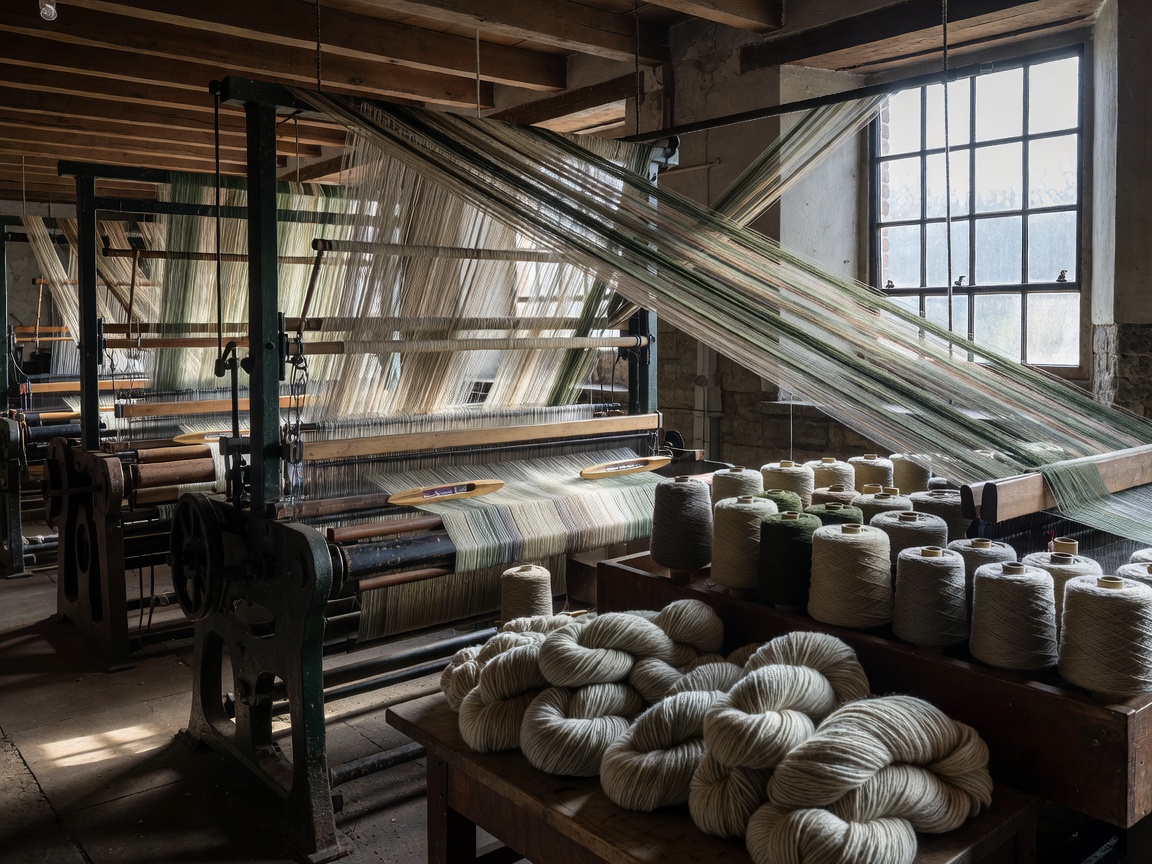
The valleys of West Yorkshire once housed over two thousand active woollen and worsted mills. Today, fewer than thirty maintain continuous loom operations. What was lost in mass volume, however, has concentrated into peerless technical mastery.
Independent houses such as London-based S.E.H Kelly and Manchester's Private White V.C. contract directly with generational weavers like Mallalieus of Delph (est. 1863) and Hainsworth (est. 1783). By guaranteeing small-batch runs of 100 to 200 meters of specialized cloth, these designers preserve historic shuttle-loom settings that produce dense, textured twills and meltons impossible on ultra-fast air-jet industrial machinery.
Key Takeaway for Buyers: Look for heavy woollen overcoats with minimum weights of 500–750 GSM. Dense wool naturally repels light precipitation, blocks wind without synthetic membranes, and holds architectural shape over decades.
The Ultimate Chore Coat: 7 European Benchmark Makers
Originally engineered for 19th-century French railway mechanics and agricultural laborers, the bleu de travail or chore jacket has become the foundational anchor of contemporary European casual tailoring. However, modern iterations diverge sharply in textile pedigree:
- Heavyweight Moleskin (France): Woven with high-density cotton shear twill creating a supple suede-like surface. Brands like Le Mont St Michel and De Bonne Facture source authentic French moleskin averaging 380–420 GSM that patinas with wear.
- Washed Twill & Ripstop (Lyon, France): Arpenteur tailors rugged French cotton twill jackets cut boxy with raglan sleeves for unrestricted shoulder articulation.
- Atlantic Brushed Canvas (Guimarães, Portugal): La Paz utilizes brushed Portuguese canvases finished with organic garment-dyes that capture softened coastal hues.
- Garment-Dyed Hopsack (Venice, Italy): Barena Venezia reinvents the chore coat with stretch hopsack wool that drapes like an unstructured cardigan while retaining three exterior utility patch pockets.
Footwear from the Hills of Mallorca: Balearic Goodyear Mastery
In the town of Inca, situated at the foothills of the Tramuntana mountain range on the Spanish island of Mallorca, cobblers have built welted footwear since 1866. Unlike fast-cemented soles that disintegrate within two seasons, Balearic artisans employ full 360-degree Goodyear welt construction and unlined French calfskins.
Makers like Carmina Shoemaker and Meermin combine vegetable-tanned leather insoles that gradually mould to the wearer's footbed with channeled oak-bark-tanned outsoles. The result is a repairable shoe engineered for decades of resole cycles.
2. Essential Fabric Benchmarks
Before investing in any garment, evaluate the underlying raw material. Independent European menswear relies on established standards:
British Ventile® & Waxed Cottons
Developed during WWII in Manchester, 100% cotton Ventile utilizes densely woven long-staple fibers that swell upon contact with moisture, providing natural water repellency without petrochemical membranes. Brands like S.E.H Kelly and Private White V.C. remain the gold standard for this construction.
Irish & French Linen
True European flax requires minimal pesticides and grows naturally along the Atlantic coastline from Normandy to Belgium. High-grade linen should possess a tactile weight (typically 200–320 GSM for shirts and trousers) and will soften with age rather than thin out.
Shetland & Scottish Spun Yarns
Mills such as Jamieson’s of Shetland spin wool from native hardy sheep. The resulting sweaters are dry to the touch, highly insulating, and resist pilling significantly better than mass-produced merino knits.
The 5-Point Atelier Checklist
- Origin Transparency: Does the label name the country and regional workshop where the item was sewn?
- Hardware Quality: Are the buttons cut from natural horn, corozo nut, or mother-of-pearl rather than polyester plastic?
- Lining Construction: In tailored jackets, is the shoulder soft and unpadded, or heavily glued with synthetic fusing?
- Loom Certification: Can the brand trace its wool or cotton back to specific European heritage mills?
- Batch Limitation: Is the maker producing limited runs of 50–300 units per style to prevent overstock waste?
3. Recommended Independent Capsule Wardrobe
A minimalist wardrobe founded on independent European manufacturing can be assembled with fewer than ten foundational garments:
- Heavy French Moleskin Chore Jacket: De Bonne Facture or Arpenteur.
- Neapolitan Soft-Shoulder Wool Blazer: Berg & Berg or Barena Venezia.
- British Heavy Tweed Overcoat: S.E.H Kelly.
- Portuguese Heavy Loopback Sweatshirt: La Paz.
- Artisan Raw Selvedge Denim: Benzak Denim Developers.